Dumpster Floor Replacement: What’s Involved and What It Costs
The floor is the first thing to die on a dumpster and the cheapest thing to fix. Here’s exactly what a floor replacement involves at our Ocala shop, how we price it, and how to tell whether yours needs a patch, a section, or the whole plate.
The Most Common Repair We Do — and the One That Buys the Most Time
A floor replacement means cutting the rotted plate out of the container and welding new steel in its place. It is the single most common job in our shop, it costs a fraction of a new can, and on a container with a straight frame it resets the clock by roughly a decade.
Here’s why it comes up so often. Wet loads sit on the same square feet of steel haul after haul. Florida humidity works on the same plate from underneath, and it never really gets a chance to dry. Five to eight years in, the floor goes soft while the walls, doors, rails, and frame above it are still perfectly sound. The can isn’t worn out. It has one worn-out part — and it happens to be the part everything sits on.
The mistake we see is waiting. A soft spot you can find with a boot heel is a sectional repair. That same spot ignored for another season becomes a hole, then a load dumped through the bottom onto a truck bed or a customer’s driveway, and now you’re replacing the container at $4,500–$8,000+ for a new roll-off instead of replacing plate. There is a wide gap between those two invoices and the only thing between them is timing.
Floor work is bread-and-butter dumpster and roll-off container repair for us — we do it every week, on roll-offs and front-load cans alike. Not sure where yours falls? Send photos through the quote form and you’ll get a straight answer before you spend anything.
How to Tell the Floor Is Done
You don’t need a gauge or a shop to call this one. Climb in with a screwdriver and walk the floor:
- Soft spots underfoot. The plate flexes where it used to feel solid. That’s thickness already gone — and steel doesn’t come back.
- A screwdriver digs in. If you can chip or punch through with hand pressure, that section is finished, no matter how it looks under the paint.
- Pinholes and daylight. Stand inside on a bright day and look down. Any light coming through means the rot has been working from underneath for a while.
- Leachate dripping from the bottom. Garbage juice leaving anywhere but the drain means the floor is already perforated. Every drop on the way out is eating more steel.
- Flaking scale, not surface rust. Streaks and bubbled paint are early. Scale you can knock off in sheets, with pitted steel underneath, is late.
- Rot creeping up the wall seam. Where the floor meets the side wall is the first place moisture pools. Rot at that seam usually means the bottom few inches of wall come out with the floor.
- The floor sounds different. Guys who load these all day hear it before they see it — a dull thud where there used to be a ring.
One soft spot in an otherwise solid can is a sectional repair and a short trip to the shop. Soft in three places usually means the whole plate is at the end of its service life — which is exactly the pattern we described in our guide to how long dumpsters and roll-off containers actually last.
What Actually Happens to Your Container
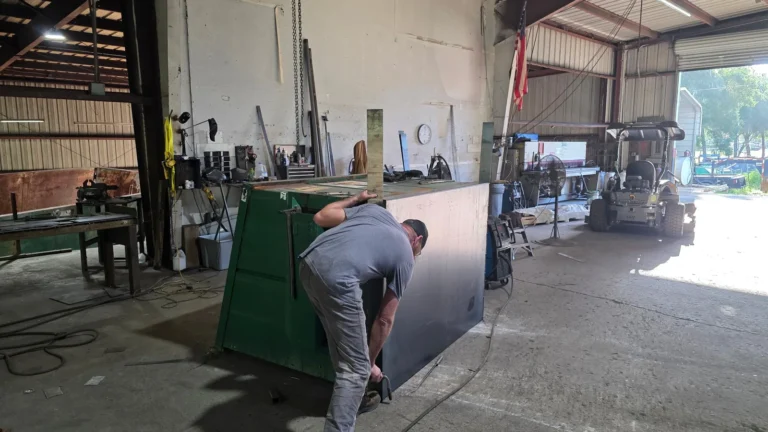
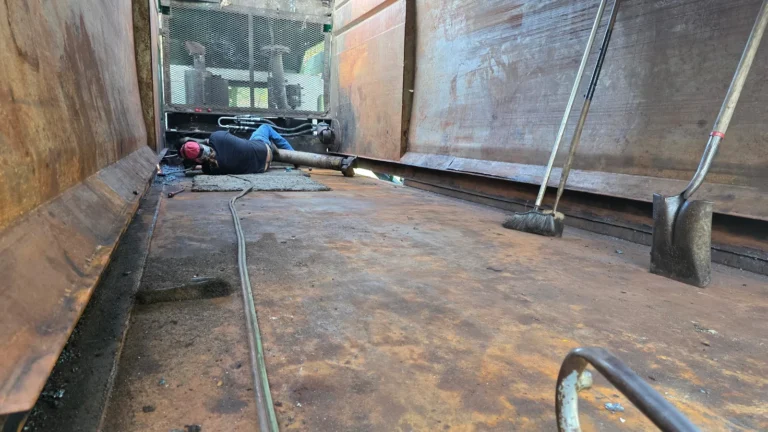
A floor replacement isn’t plate laid over plate. Done right, it’s a rebuild of the bottom of the container:
1 · Strip & Assess
The can comes in empty and gets cleaned out so we can see bare steel. We sound the whole floor, check the wall seams and cross members underneath, and map exactly how far the rot runs — which is usually farther than it looks from inside.
2 · Cut Out the Rot
Everything compromised comes out — the plate, the bad bottom of the wall if the seam is gone, and any cross member that’s rotted with it. We cut back to solid steel. Welding new plate to thin steel just moves the failure six inches.
3 · New Plate In
Fresh steel is measured, cut, fitted, and welded in — sections or a full floor, matched to the gauge the container was built with. Seams get welded through, not tacked, so the repair outlasts the panel around it.
4 · Prep & Paint
New steel gets prepped, primed, and painted. Paint isn’t cosmetic on a floor — it’s the corrosion barrier that decides whether this repair lasts eight years or three. Your logos and numbering go back on before it leaves.
While the can is on the floor it’s cheap to fix what’s next in line — a sagging door, a split seam, a bent rail. That’s not an upsell, it’s freight math: a second trip to Ocala costs more than the repair usually does. We’ll show you photos of what we found and let you decide.
Section, Full Floor, or Stop Spending?
Three levels of the same job. Cost is relative to a new roll-off at $4,500–$8,000+, because that’s the number every repair decision is really measured against.
| Scope | When it’s the right call | What we do | Cost vs. a new can |
|---|---|---|---|
| Sectional repair | One or two soft areas, rest of the plate still solid | Cut out the bad sections, weld in new plate, prime and paint | Low — a small fraction of new |
| Full floor replacement | Soft end to end, or three-plus separate spots — walls and frame still sound | Whole floor out, new plate in, wall seams re-welded, full prep and paint | Moderate — still well under half of new |
| Floor + lower walls | Rot has climbed the wall seam and taken the bottom of the side panels | Floor plus the bottom band of wall replaced as one repair | Moderate — run the 50–60% math |
| Replace the container | Frame racked or cracked, or steel thin everywhere with nothing solid to weld to | Nothing — we’ll tell you to put the money toward a new can | High — repair dollars are wasted here |
That last row is real. We’d rather lose one job than take money for a floor in a container that can’t hold it — the same honest math we lay out in our repair-vs-replace guide and the 50–60% rule.
Why We Quote From Photos Instead of a Price List
Two cans that look identical in a yard can quote hundreds apart. These are the six things that decide it:
- Square footage of plate. A 40-yard roll-off floor is a lot more steel than a 6-yard front-load can. This is the single biggest line on the quote.
- Steel gauge. Roll-off floors carry the heaviest plate on the container by design — heavier than the side walls — and we match what it was built with. Heavier plate costs more and lasts longer.
- Sectional or full. Patching two spots is hours. A full floor is a day’s work with more cutting, more fitting, and more weld.
- How far the rot climbed. If the wall seam is gone, the bottom band of wall comes out with the floor. Finding this at teardown is normal; finding it in a photo is not, which is why we look before we quote.
- What’s underneath. Rotted cross members or a rusted understructure add steel and labor. On a can that sat loaded in the weeds for a season, this is common.
- Paint scope. Prime-and-paint over the new steel is standard. A full-can repaint with logos back on is a bigger job — and often worth doing at the same time, since the can is already here.
Send photos of the inside floor, the outside bottom, and the wall seams, plus the container size, and we’ll come back with a real number and a date — not a range designed to be revised later. If you’re close by, our Ocala dumpster and roll-off repair shop is at 4240 SE 95th St; roll-offs get dropped off, and front-load cans we can pick up and deliver back.
How to Make the Next Floor Last Longer
A floor replacement resets the clock. What you do afterward decides how long the new one runs:
Rotate the Wet Work
Concrete washout, wet demo, food waste — if the same two cans catch all of it, those two floors die years before the rest of the fleet. Spread it around and the whole fleet ages evenly.
Fix Paint Before It’s Rust
Paint is the corrosion barrier. Bare steel left through a Florida summer gives rust a multi-year head start, and it always starts at the floor. Touch-up is cheap; plate is not.
Don’t Park Them Loaded
A can sitting on dirt with wet debris inside rots from both sides at once. An idle container corrodes faster than a working one that gets emptied and dried out on a route.
Same failure, bigger machine: the hopper and packer floors on refuse trucks rot for exactly the same reason, and the warning signs read the same way — here are the signs a garbage truck body needs repair.
Dumpster Floor Replacement — Common Questions
What haulers, cities, and property managers ask us about floors. Got a specific can? Send photos.
How much does a dumpster floor replacement cost?
Can you replace just part of the floor?
How long does a floor replacement take?
How long will the new floor last?
Is it worth replacing the floor on a 10-year-old container?
Do you replace floors on front-load dumpsters as well as roll-offs?
Can you weld a patch over the rusted floor instead?
Floor Going Soft? Send Us Photos.
Snap the inside floor, the outside bottom, and the wall seams, and send them through the quote form. We’ll tell you straight whether it’s a section, a full floor, or a can you should stop spending money on — plus what it costs and when you’d have it back.