Signs Your Garbage Truck Body Needs Repair or Refurbishment
A refuse truck that’s down earns nothing — and body rot never gets cheaper by waiting. Here are the warning signs we see on every truck that comes through our Ocala shop, which ones can wait for the next service window, and which ones can’t.
Catch It While It’s Still a Weld, Not a Rebuild
Garbage truck bodies don’t fail overnight. They telegraph it — rust streaks at the seams, a soft spot in the hopper floor, a hairline crack at a hoist mount. Every one of those signs is cheap to fix early and expensive to ignore.
The steel body on a garbage, roll-off, or refuse truck takes more abuse than anything else on the vehicle. It gets packed against, dead-lifted, slammed, and — worst of all in Florida — it holds wet garbage against the same steel plate every single route. Leachate is corrosive, humidity never lets the steel dry out, and the packing cycle flexes every weld thousands of times a month. The chassis under the body might be good for another decade; the body is where the truck actually wears out.
Here’s the part that matters for your budget: body damage is progressive. A split seam is a cheap weld today; left alone, it lets water into the floor structure and next year it’s a floor replacement. A new refuse truck runs well into six figures before it hauls a single can — keeping the body you already own alive is almost always the better math. That’s exactly what our garbage and roll-off truck body repair and refurbishment crew does all day.
See something on your truck in the list below? Send us photos through our quote form and we’ll tell you straight whether it can ride until the next service window or needs to come in now.
What a Failing Truck Body Looks Like
Walk around the truck at the end of a route and look for these. Most bodies that end up needing major work showed at least three of them first:
- Rust streaks and bubbling paint at the seams. Corrosion working from behind the paint. Surface streaks are early-stage; flaking scale and pitting mean the steel underneath is already losing thickness.
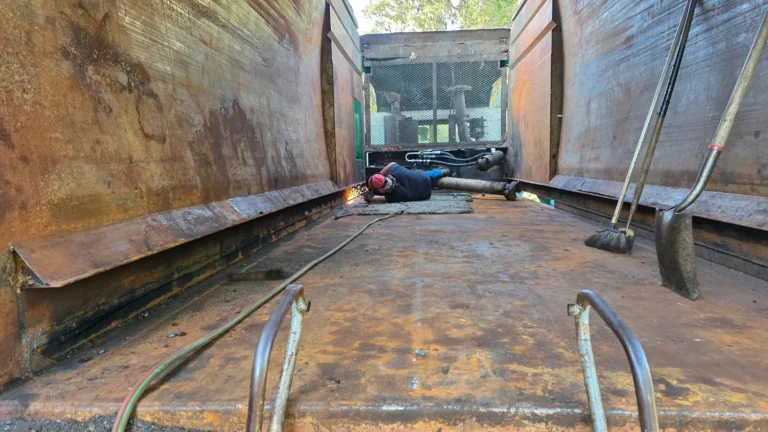
- Soft spots or holes in the hopper or packer floor. The #1 killer, same as on containers. Leachate pools on the floor plate and rots it from the top down. If a shovel or boot heel finds soft steel, the floor is telling you it’s on borrowed time.
- Leachate dripping from body seams on the route. Garbage juice leaking from anywhere but the designed drain means a seam has split or a panel has rotted through — and every drop is eating more steel on its way out.
- Cracks at the stress points. Hoist mounts, hinge points, corner posts, and the ends of long welds. Hairline cracks grow with every packing and dumping cycle — they never get smaller.
- A tailgate that won’t seal or hinges that sag. A leaking tailgate drips on every street you run and pushes the gate frame further out of square each time it slams.
- Bulging or oil-canning body panels. Packing pressure deforming steel that’s gotten too thin to hold its shape. Bulged panels are a thickness warning, not just a cosmetic one.
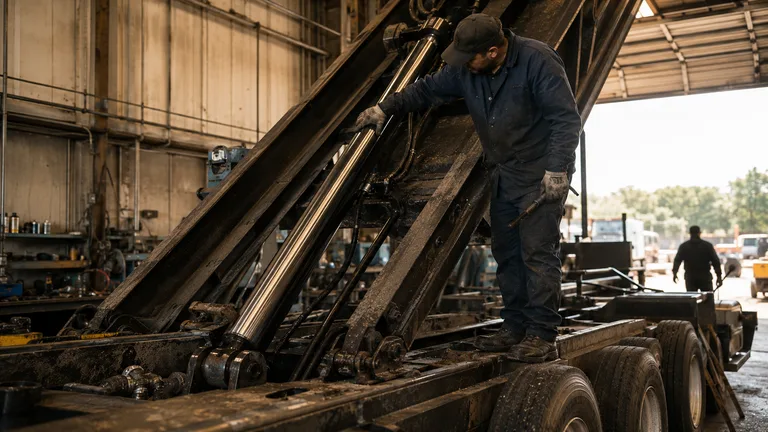
- Bent long rails or hoist rails on roll-off trucks. Impact and dead-lift damage. Bad rail geometry chews up rollers and hooks and gets a little worse with every can you load.
Fix Now, or Monitor?
Rough triage from the shop floor. When in doubt, photos settle it — that’s what the quote form is for.
| Sign | What it usually means | Fix now or monitor? |
|---|---|---|
| Surface rust streaks, paint bubbling at seams | Corrosion started behind the paint; steel still sound underneath | Monitor — schedule prep & repaint before it goes structural |
| Flaking rust scale, pitted steel you can chip with a screwdriver | Plate is actively losing thickness | Fix soon — cut out and replace the affected sections |
| Soft spots or holes in the hopper/packer floor | Floor plate rotted from trapped leachate | Fix now — floors only get worse, and a dropped load costs far more than plate |
| Leachate leaking from body seams | Split seam or rotted-through panel | Fix now — it’s corroding the structure and dripping down every street you run |
| Hairline cracks at hoist mounts, hinges, corner posts | Stress cracking — grows with every cycle | Fix now — a crack caught early is a gouge-and-reweld, not a rebuild |
| Tailgate won’t seal; hinges sagging | Hinge wear or a gate frame going out of square | Fix soon — it leaks on every haul and the racking accelerates |
| Bulging / oil-canning body panels | Steel too thin to hold shape under packing pressure | Have it looked at — often a section replacement; sometimes a refurb trigger |
| Bent long rails or hoist rails (roll-off) | Impact or dead-lift damage throwing off geometry | Fix now — bad geometry damages rollers, hooks, and every can you load |
“Monitor” never means forget about it. It means put it on the list for the next scheduled window — and check it again at the end of the month.
How Much Work Does the Body Actually Need?
One sign is a repair. Several signs at once usually means the body is due for a bigger decision:
Spot Repair
One isolated problem on an otherwise sound body — a cracked hoist mount, a split seam, a section of soft floor. We cut out what’s failed, weld in new steel, and the truck is back on the route. This is the cheap window. Most of the signs above live here if you catch them early.
Full Refurbishment
Three or four signs at once — floor going soft, seams weeping, rust scale spreading — means patching one spot just moves the failure to the next one. A full refurb resets the body: rot cut out, new floor and panel steel welded in, stress points reinforced, then prep, prime, and repaint with your livery back on. A mid-life refurb is how a body outlasts its second chassis.
Replacement
When the steel is thin everywhere and there’s nothing solid left to weld to, we’ll tell you — we’d rather lose one job than refurb a body that can’t hold it. The math is the same 50–60% rule we use on containers: here’s how we call repair vs. replace on a dumpster, and the truck-body version works identically.
What We Fix — and What We’ll Send You Elsewhere For
We’re a steel shop, not a truck dealership. Knowing exactly what we do is why haulers trust the answer they get.
We handle the body and its structure: hopper and packer floors, body and bed panels, tailgates, hinges and latches, hoist frames and long rails, corner posts, cracked and split welds, full rust cut-out and rebuild, and complete refurbishment with repaint. Hoist and tailgate cylinders are the one hydraulics job we take in-house — our hydraulic cylinder repair and resealing bench rebuilds them while the body work happens, so the truck leaves whole.
We don’t touch the drivetrain. Engines, transmissions, brakes, emissions — that’s a truck mechanic’s work, and we’ll tell you so on the first phone call rather than learn on your truck. If the body is sound and the problem is under the hood, we’re not your shop — and if the drivetrain is sound but the body is failing, nobody in the region does that steelwork better.
Truck Body Repair — Common Questions
What haulers and fleet managers ask us about failing bodies. Got a specific truck? Send photos.
How do I know if the rust on my garbage truck body is cosmetic or structural?
Can you replace just the hopper or packer floor without rebuilding the whole body?
Do you repair garbage truck engines or transmissions?
Is refurbishing an old truck body worth it compared to buying a new truck?
How long does garbage truck body repair take?
See One of These Signs on Your Truck?
Snap a few photos and send them through our quote form. We’ll tell you straight what can wait, what can’t, what it’ll cost, and when you’d have the truck back on the route.